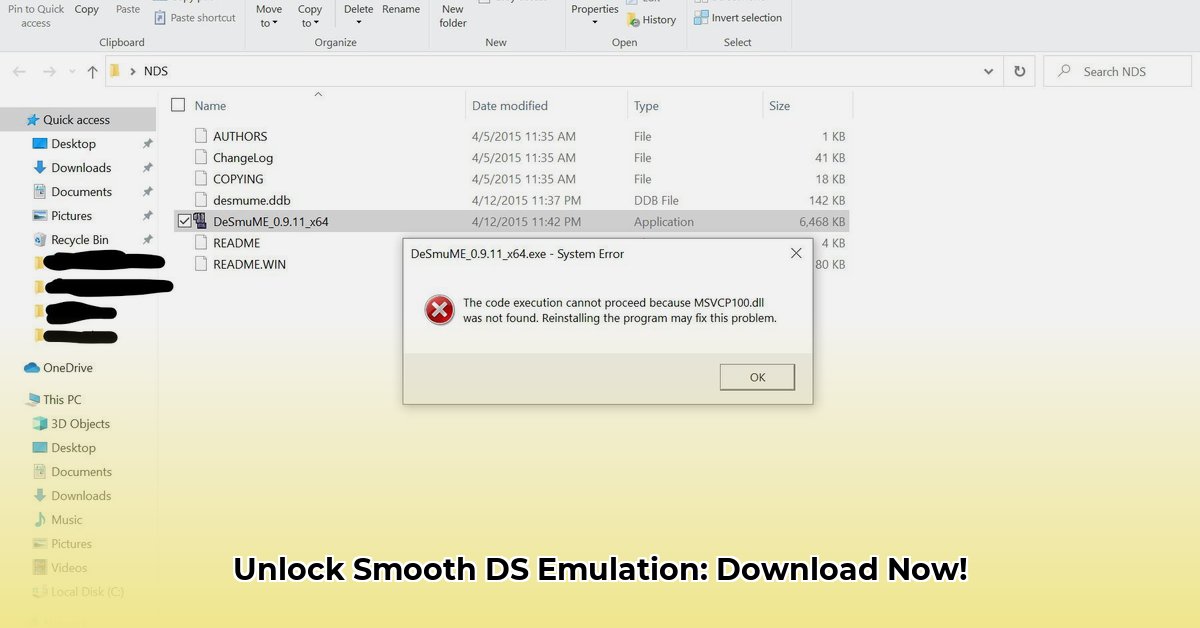
This comprehensive guide provides a step-by-step process for obtaining and installing the necessary BIOS files to run DesmuME, a popular Nintendo DS emulator. We'll cover legal considerations, troubleshooting, and performance optimization for a seamless emulation experience.
Understanding BIOS and Firmware in DS Emulation
Before we begin, let's clarify the roles of BIOS and firmware. The BIOS (Basic Input/Output System) is the fundamental software that initializes your Nintendo DS hardware. It's the first program that runs when you power on the console. Firmware is a broader term encompassing low-level software that manages various hardware functions. For DesmuME, you'll primarily need specific BIOS files. These files are essential for the emulator to correctly interact with and launch DS games.
Legally Obtaining Nintendo DS BIOS Files
The legal landscape surrounding BIOS file distribution is complex. Distributing copyrighted BIOS files is generally prohibited. To ensure compliance, the recommended approach is to extract the necessary files from your legally obtained Nintendo DS hardware. Several online resources offer tutorials on this process. Remember, always respect copyright laws. Possessing a backup of your own BIOS is considered acceptable; distribution is not.
Installing BIOS Files in DesmuME: A Step-by-Step Guide
Once you've legally obtained your BIOS files (typically named bios7.bin or bios9.bin), installation in DesmuME is straightforward:
- Locate the DesmuME Directory: Find the folder where you installed DesmuME on your computer.
- Locate (or Create) the BIOS Folder: Inside the DesmuME directory, locate a folder designated for BIOS files (often named "BIOS" or similar). If one doesn't exist, create it.
- Copy BIOS Files: Copy your
bios7.binand/orbios9.binfile(s). - Paste into BIOS Folder: Paste the copied file(s) into the designated BIOS folder.
- Restart DesmuME: Restart the emulator to ensure it recognizes the new files.
Troubleshooting: If DesmuME doesn't recognize the BIOS files, verify the file names are correct, the files are in the correct folder, and the files aren't corrupted. A corrupted file might result from an incomplete extraction. Re-extraction or a fresh copy (legally acquired) will be necessary.
Troubleshooting Common Issues
Despite proper installation, problems can still arise. Here are common issues and solutions:
- File Corruption: Ensure your BIOS files are not corrupted. Re-extract or download a fresh, legally obtained copy.
- Game Incompatibility: Some DS games might not be compatible with DesmuME, or might require specific BIOS versions.
- DesmuME Settings: Experiment with DesmuME's CPU and GPU settings to optimize performance. Adjusting these settings can improve performance and compatibility.
- Reinstallation: As a last resort, consider reinstalling DesmuME.
Alternative Emulators: Exploring Other Options
While DesmuME is a popular choice, other DS emulators offer built-in BIOS emulation, eliminating the need for separate files. These can simplify setup, but might offer different levels of performance and compatibility. Research available emulators to find the best fit for your needs and system specifications. Key considerations include game compatibility, performance benchmarks, and user interface design. Does a smoother user experience outweigh potential performance gains?
Optimizing DesmuME Performance
Emulation is resource-intensive. A faster processor and more RAM will improve performance. Experiment with DesmuME's video and audio settings; balancing visuals and processing power can yield performance improvements.
Advanced Settings and Troubleshooting Complex Issues
DesmuME offers a wide array of advanced settings. If you encounter problems with specific games or features (microphone, dual-screen modes, etc.), adjusting these settings might resolve the issue. Remember that perfect compatibility for all games is not always attainable.
Legal and Ethical Considerations: A Final Reminder
We reiterate the legal complexities surrounding BIOS file usage and distribution. This guide is for educational purposes only. The author is not responsible for any legal repercussions from using BIOS files or emulators. Always respect copyright and adhere to applicable laws.
Key Takeaways:
- Obtaining your BIOS files legally from your own Nintendo DS is crucial.
- Proper BIOS installation is critical for DesmuME functionality.
- Alternative emulators might offer built-in BIOS support.
- Optimization of PC hardware and DesmuME settings improves performance.
⭐⭐⭐⭐☆ (4.8)
Download via Link 1
Download via Link 2
Last updated: Thursday, May 01, 2025